The Machinery Doctor: Diagnosing Silent Failures Before They Kill Your Equipment
 When Machines Go Quiet—That’s When You Should Worry
A silent machine doesn’t mean a healthy machine—it means it’s hiding its symptoms.
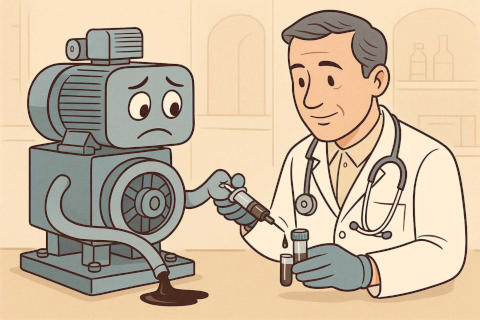
Imagine treating a patient who can’t speak or explain where it hurts. You rely entirely on observation, vital signs, and test results. Now replace the patient with a high-value machine, and the clinic with your plant.
This is the reality of modern industrial maintenance. Machines don’t communicate in words, but they constantly send signals. The challenge today isn’t just noticing those signals—it’s knowing how to read them early enough to avoid failure.
With rising downtime costs, ageing assets, and increasing pressure on reliability metrics, the role of the reliability professional has evolved. Today, you’re not just a technician—you’re the diagnostic frontline of plant performance.
Observation 2.0: Seeing the Right Signals at the Right Time
Modern observation goes beyond watching for leaks or listening for noise.
Today’s best practices include:
- Daily walk downs with digital checklists
- Visual inspections linked to mobile apps or CMMS
- Capturing trends via thermal cameras, vibration sensors, or AI-enabled cameras
Visual cues—like a dusty motor or a bypassed breather—are no longer anecdotal. They’re data points. And they matter more than ever in Condition-Based Maintenance (CBM).
The Role of Observation 2.0 in Industry
4.0 Frameworks
Industry 4.0 involves integrating cyber-physical systems, IoT devices, and data-driven decision-making into manufacturing and maintenance. Within this framework, Observation 2.0 refers to the use of sensors, thermal imaging, ultrasonic tools, and mobile inspections to capture machine health data.
These tools enable real-time monitoring, reduce reliance on subjective checks, and feed structured data into CMMS and predictive analytics systems.
As the sensory layer of Industry 4.0, Observation 2.0 supports early fault detection, automated diagnostics, and the shift from reactive to predictive maintenance.
The Reliability Check-Up: Non-Invasive but Deep
In medicine, imaging changed diagnosis forever. In maintenance, it’s tools like:
- Wireless vibration sensors
- Thermal imaging via drones or fixed cameras
- Ultrasonic leak detection and bearing lubrication monitoring
These aren’t add-ons anymore—they’re baseline requirements in any predictive maintenance (PdM) program.
Paired with smart data logging, these tools enable remote monitoring, helping plants move from reactive firefighting to proactive decision-making.
 Oil Analysis: Still the Most Underrated Diagnostic Tool
Despite advances in sensors and AI, lubricant analysis remains one of the most cost-effective condition monitoring tools, mainly when used consistently and interpreted correctly.
Trends we now look for:
- Wear metal trending instead of single-event spikes
- Particle count vs PQ index to detect root cause vs symptom
- Additive profiling to detect incorrect oil top-ups or thermal stress
- Moisture intrusion analysis in the context of seasonal/environmental data
Many plants are now integrating oil analysis directly into their maintenance dashboards, triggering alerts and work orders based on lab results.
Note: While additive replenishment is technically possible, it is not common practice except in large-scale or tightly controlled systems like turbines. For most systems, oil replacement is the recommended approach.
Prescriptive Maintenance: Your Machine’s Treatment Plan
Once the diagnosis is in, the goal is targeted intervention, not just blanket maintenance.
This can include:
- Inline filtration systems or kidney loop flushing
- Microfiltration to extend oil life instead of frequent change outs
- Load balancing and alignment for stress reduction
- Lubrication automation with feedback-based greasing
The trend is toward data-driven prescriptions, where maintenance is customized based on operating conditions, not OEM checklists alone.
Prevention, Now Powered by Predictive Intelligence
The saying still holds: prevention is better than a cure. But today, prevention is no longer based on gut feeling—it’s powered by:
- AI-based failure pattern recognition
- Digital twins for critical systems
- MTBF-linked risk modelling
- Training frontline staff to recognize failure modes in real time
Good lubrication, clean oil, and aligned equipment are still non-negotiables. But so is your organization’s ability to act on insights quickly and make the preventive mindset part of daily operations.
From Maintenance Tech to Reliability Diagnostician
Your machine is talking. Maybe not loudly—but clearly.
Modern reliability isn’t about responding to failure. It’s about reading the signs, confirming them with data, and intervening just in time. That’s not just maintenance—it’s diagnosis. And the people who master this are no longer seen as back-end support. They’re strategic contributors to uptime, sustainability, and profit.
Like doctors, we can’t wait for the emergency room moment. We have to act early, interpret quietly raised red flags, and keep our machines alive—efficiently, responsibly, and reliably.
