The Cholesterol Trap : Why ‘Normal’ Oil Reports Can Lead To System Heart Attacks
 In the field of industrial maintenance, we often rely on laboratory reports as we often rely on laboratory reports as the definitive benchmark for lubricant health. We scan the results for “Red” or “Yellow” flags, and if everything looks “Green,” we assume the machine is safe. However, there is a critical discrepancy frequently observed in ageing systems : a lubricant that has been in service for over a decade returns a “Normal” report, while the machine itself is on the verge of a catastrophic failure.
This situation is strikingly similar to a human medical check-up. Imagine a person who looks fit, has a normal body temperature, and a steady pulse. To a basic observer, they are healthy. But deep within their arteries, cholesterol is silently accumulating. Their “basic” vitals are fine, but their “lipid profile” indicates a latent critical risk. In turbine systems, ignoring the “cholesterol” of the oil—varnish precursors — is significantly increasing the risk of unpredicted failure
The Illusion of the “Clean” Report
Consider a common scenario: A turbine oil has been circulating for maybe 10 or 12 years. The maintenance team notices the oil has turned a dark, tea-like colour. Suspicious, they send a sample to the lab. The results come back : Viscosity is stable, Total Acid Number (TAN) is normal, water content is normal, and Wear Metals are well within limits.
The report is “Green.” The team is told to “Continue Monitoring.” Yet, a few months later, a critical servo valve sticks, or a bearing temperature suddenly spikes. Upon opening the system, they find a thick, brown, lacquer-like coating on the metal surfaces. How can a ‘healthy’ report lead to such a catastrophic failure? The answer lies in the limitations of standard diagnostic “vitals.
Why Standard Tests Often Function as an Initial “Pulse Check”
Standard oil analysis packages are primarily effective for identifying acute changes in lubricant health. Much like a routine temperature or heart rate check, these tests are essential yet may not fully capture chronic, internal degradation such as the gradual Figure 1: Diagnosing the Silent Killer — Identifying varnish precursors as industrial cholesterol to prevent catastrophic turbine failure buildup of varnish precursors:
- Viscosity and TAN : These parameters are best understood as lagging indicators. Typically, by the time viscosity or acidity rises significantly, the lubricant May have already reached an advanced stage of degradation.
- Elemental Analysis (ICP): This test “sees” metallic particles. It is often ineffective at detecting organic “sludge” (varnish) that plates out on critical turbine components.
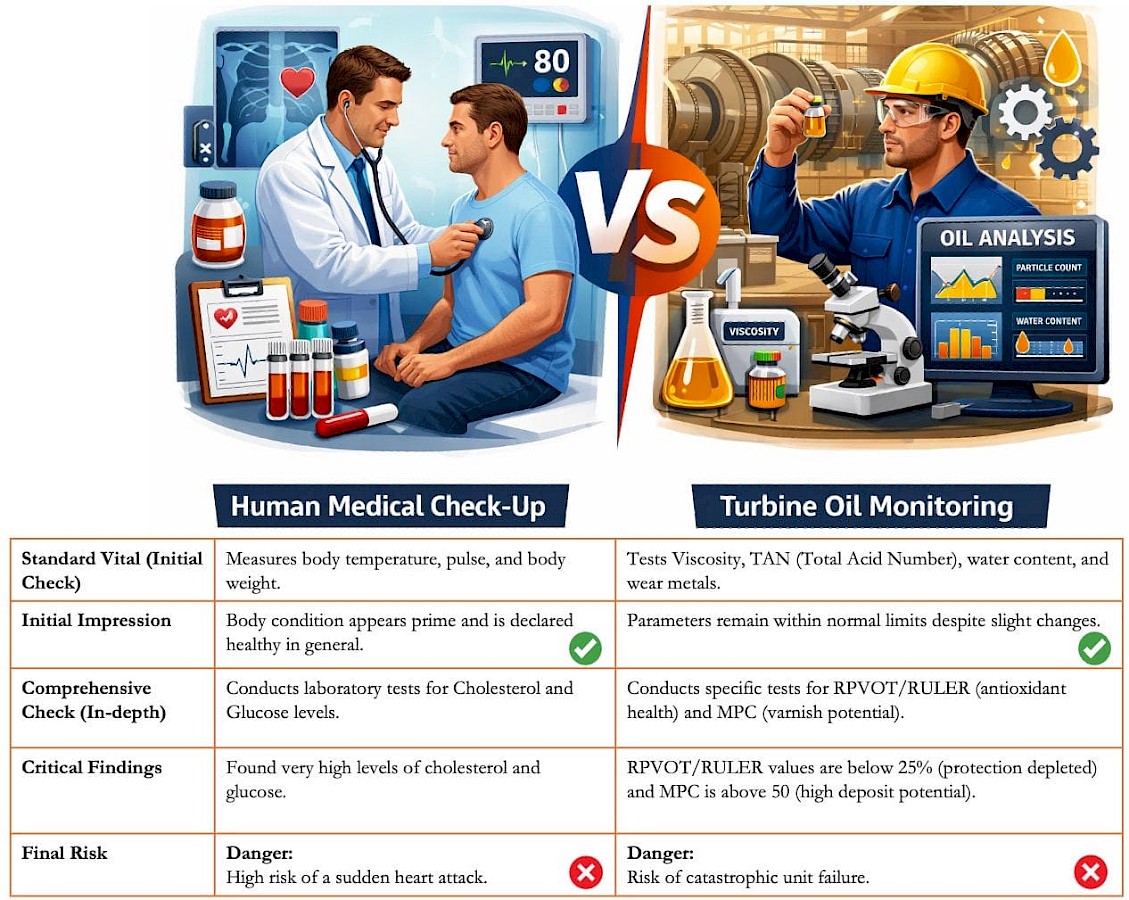
The “Lipid Profile” for Turbines : The Critical Three
To truly understand the health of an ageing turbine lubricant, you must look at the tests that measure the “unseen” risks. If your oil is more than five years old (or maybe faster for gas turbine), these three tests are essential components of your monitoring strategy :
-
MPC (Membrane Patch Colorimetry) – Measuring the Plaque
MPC (ASTM D7843) is the direct equivalent of a cholesterol test. It pulls a sample through a filter and measures the colour intensity of the residue. This test captures the “soft” contaminants that standard tests ignore. A high MPC value means your oil is “saturated” and starting to dump “plaque” (varnish) onto your valves. -
RULER (Remaining Useful Life Evaluation Routine) – The Immune System
In our bodies, certain factors help manage cholesterol. In oil, that role is played by antioxidants. RULER (ASTM D6971) quantifies the concentration of these additives. If your an- tioxidants are depleted, the oil has lost its “immune system.” Even if the oil looks “Normal” today, it has no defence against the heat of tomorrow. -
RPVOT (Rotating Pressure Vessel Oxidation Test) – The Stress Test
RPVOT (ASTM D2272) is the “cardiovascular stress test” for your lubricant. It subjects the oil to extreme oxidation pressure to see how much “stamina” it has left. For an oil that has served for 10 years, RPVOT reveals whether the fluid is still capable of protecting the ma- chine or if it is on the brink of total breakdown.
If your maintenance team reports varnish deposits or dark oil, but the lab report says “Normal,” the lab hasn’t failed—your test- ing suite has. Field observations (color, valve sluggishness) are the “symptoms.” Never ignore a symptom just because the “pulse check” (Viscosity/TAN) looks fine.
Conclusion
We would never accept a medical check-up that ignores cholesterol for a patient at risk. Why should we treat our multi-million dol- lar turbines any differently? For aging tur- bine lubricants, A ‘Normal’ status can create a false sense of security if not validated by complementary tests. By integrating MPC, RULER, and RPVOT into your monitoring regime, you transition from reactive witness- ing to proactive reliability. Don’t wait for a “system heart attack” to realize your oil’s ar- teries were clogged all along.
