
Industrial Lubricants
Beyond Price Per Liter: RELIC, a New Reliability-Driven Framework for Lubrication Cost Control
The RELIC framework connects lubricant price and consumption with oil condition and equipment reliability to improve lifecycle cost decisions.
Introduction
Global crude oil volatility has moved from being cyclical to structural. Base oils derived from crude oil account for 70-90% of the composition of lubricant fluids. For lubricant-dependent industries in India, where most demands are met by imports, this volatility in crude prices directly impacts base oil pricing, additive costs, packaging, and ultimately the maintenance budgets.
However, the critical mistake many organizations make is treating lubrication purely as a cost center. Drawing from experience across emerging and developed lubricant markets, a more effective approach is to treat lubrication as a reliability control system under cost pressure, rather than a consumable exposed to price fluctuations. Rising lubricant costs have led procurement teams to closely evaluate the unit cost increases, the magnitude of change, the timelines, and, most importantly, the impact on the Total Cost of Operations.
Behind most of this is crude oil volatility. This article introduces the RELIC model, an original framework developed by the author that integrates lubrication cost variables with reliability outcomes, addressing a gap in conventional cost-focused maintenance approaches.
Lubricant Cost Trends Are Different from Fuel Prices
Fuel prices like diesel and petrol change frequently, whereas lubricant prices operate with a lag:
Manufacturers maintain inventories of bulk fluids, raw materials, and finished goods.
Channel partners maintain product inventory and also a certain level of safety stock.
Certain prices, as per contractual agreements, need to be maintained. As a result, maintenance teams often experience a false sense of pricing stability, followed by delayed cost corrections. This lag creates a narrow but real window for proactive decision-making if teams are aligned.
Common Cost-Cutting Responses and Their Risks
The rise in lubrication costs often leads teams to the following conventional solutions.
Extending oil drain intervals
Switching to lower-cost lubricants
Reducing oil analysis frequency. While all these actions appear reasonable, these solutions often increase latent failure risk. The Indian operating environments are characterized by:
Elevated temperatures
High particulate contamination
Variable load conditions These operating conditions place continuous stress on lubricant performance.
The Hidden Cost of Saving on Lubricants
Lubrication is a very small share of the overall operating cost – often less than 5%- but the influence on reliability is disproportionately high. As a result, even smaller savings in lubricant cost may lead to larger operational issues by:
Negative effect on the life of equipment bearings.
Gearboxes run hotter.
Oil degrades sooner due to contamination. All these may lead to frequent equipment failure; in turn, what looked like a cost-saving measure turns into operational stress caused by:
Productivity loss due to downtime
Increased costs due to emergency maintenance
Higher spare parts consumption Despite their low share of total cost, lubricants disproportionately influence overall equipment lifespan, increased maintenance frequency, and downtime-related productivity losses. Industry studies and field observation indicate:
Poor contamination control can reduce lubricant life by 30-50%
Condition-based oil management can extend oil life by 15-25%, depending on application stability. This asymmetry makes lubrication a critical- but often underestimated- area for cost control. Unlike traditional Total Cost of Ownership (TCO) approaches or previous Reliability-Centered Maintenance (RCM) frameworks, the RELIC Model clearly defines the variables of lubrication cost in relation to real-time equipment reliability degradation.
The RELIC Model: A New Practical Approach
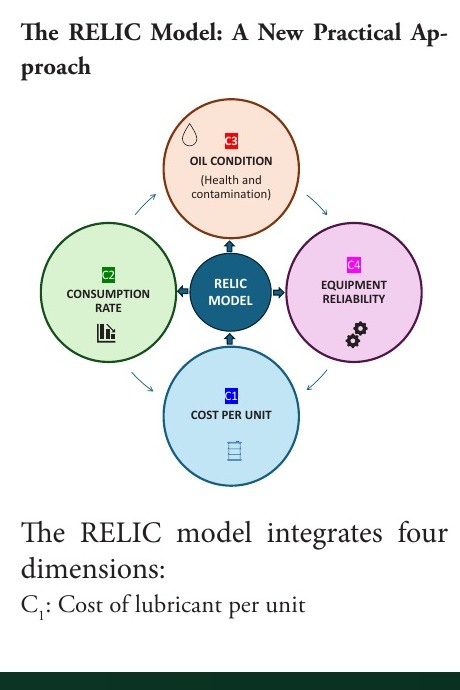
The RELIC model integrates four dimensions: C1: Cost of lubricant per unit. C2: Consumption rate of lubricant. C3: Condition of oil health and contamination.
C4: Equipment reliability (output performance). TCOL means total cost of lubrication. Model representation: TCOL = (C1 x C2) + f(C3, C4).
Key Insight
Field observations across industrial lubrication practices indicate that most organizations optimize decisions based solely on C1 (Price), while C3 (Condition) and C4 (Reliability) remain under weighted in overall decision-making. The RELIC Model shows that minimizing lubricant price alone increases total cost if it degrades condition integrity (C3) and reliability (C4).
RELIC Model in Practice
1. Condition-Based Lubrication Decisions vs. Time-Based Practices
Transitioning from calendar-based oil change to data-driven decisions using:
Oil analysis
Viscosity tracking
Monitoring contaminants is another important factor. This reduces unnecessary oil changes while preventing premature degradation.
2. Consumption Optimisation
Eliminate over-lubrication.
Stop any loss due to leakages.
Lubrication practices and consolidation of stock-keeping units
3. Performance-Based Selection vs. Low-Cost Lubricants
Evaluating cost per operating hour, not per liter
Synthetic lubricants have better lifecycle benefits.
Low-cost oils with lower quality are associated with higher risks.
4. Reliability Dependency Loop
Root cause analysis is needed, linking them to lubrication and value.
Integrate with the predictive maintenance system.
Use downtime cost as a decision variable.
5. Control Contamination
Dust and moisture are constant challenges in Indian environments. Lubrication performance drops rapidly once contamination enters the system, regardless of the fluid’s quality. Operational consciousness leads to improvements and lower exposures:
Storage areas and the warehouse are kept clean and well-marked.
Lubrication is transferred as per the correct protocols.
Installing or upgrading filtration systems Cleaner oil lasts longer, which, in turn, directly reduces costs.
6. Collaborate on Shared Objectives
Maintenance and procurement functions must operate in alignment, supported by structured communication and shared performance objectives. An optimized cost can be achieved when:
Plan purchases instead of reacting to price spikes and trying to time the market.
Lock in supply where possible based on overall financial merit and liquidity.
Avoid last-minute buying during high price periods. C3 OIL CONDITION (Health and contamination) C4 EQUIPMENT RELIABILITY C1 COST PER UNIT C2 CONSUMPTION RATE RELIC MODEL Planning with financial worthiness analysis, along with inventory optimization, can significantly smooth out cost fluctuations.
7. Use Data Where Possible
AI-enabled digital tools are increasingly used to support lubrication decisions, with predictive models improving scenario building. Additionally, it also offers improved:
Online oil monitoring
Predictive maintenance tool kit
Digital tracking of lubricant usage These data also help identify outliers in consumption trends, highlighting where oil is being overused or wasted, or where equipment has a higher failure risk. There are documented cases where switching to higher-performance oils (including synthetics where needed) has reduced overall consumption and improved equipment life—even when the price per litre was higher.
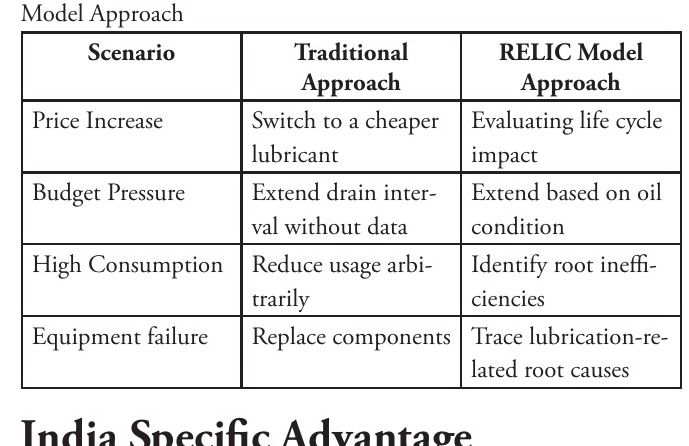
Practical Application Matrix
India-Specific Advantage
The RELIC model is particularly relevant in India due to the following factors:
High dust > Impacts C2 conditions
Cost pressure> Impacts C1 decisions
Aging equipment> Sensitive to C4 reliability
Import dependency > Volatility in C1 pricing. These specific operating conditions create a structurally different lubrication decision environment compared to developed markets, reinforcing the need for an integrated cost-reliability model such as RELIC.
Case Study: Moving from Time-Based Practice to RELIC
A mid-sized industrial manufacturing plant in Central India faced frequent downtime in its rotating equipment. The maintenance team observed unexpected, recurring bearing failures despite scheduled maintenance practices, resulting in unnecessary lubricant expenditure on certain equipment. As part of root cause analysis (R.C.A.), the plant implemented a condition-based lubrication strategy using periodic oil analysis, contamination monitoring, and viscosity trend tracking.
Equipment criticality was mapped against lubricant health indicators under the RELIC framework. Instead of changing lubricants solely based on operating hours or lubricant price, interventions were triggered by real-time oil condition data. Within nine months, the facility took action on storage, controlling contamination at dispensing, and transitioning away from poor-quality, low-cost lubricants, reducing lubricant consumption by 14% while improving equipment reliability.
This also significantly reduced unplanned downtime related to lubricants. This also helped improve maintenance planning, which became more predictable during the period of crude oil volatility.
What This Means for Indian Industry
Crude oil volatility is not temporary; it is structural now. The difference comes down to approach:
Maintenance teams that treat lubrication as a cost tend to struggle.
Whereas considering it as a reliability function tends to perform better over time In a country where operating conditions are tough and margins are often tight, getting lubrication right is one of the most practical ways to improve both cost control and uptime. The RELIC Model enables prioritization of both cost and equipment reliability- two key variables that are traditionally treated as competing priorities in industrial maintenance practices.
Conclusion
Rising lubricant costs can put real pressure on operational decisions—but reacting by cutting lubrication practices is rarely the right answer. A practical approach in these times of price volatility is by
Using condition-based oil change decisions
Focus on lubricant performance, not just price alone.
Control contamination
Align maintenance and procurement.
Use data for continuous optimization. The RELIC approach represents a shift from cost-centric lubrication management to a reliability-integrated decision system in operations. The ultimate goal is not just to minimize spending, but to get more value from every liter used- while keeping machines running reliably. Because in operations, the real cost is rarely the lubricant itself. It is the consequence of lubrication failure.
About the Author
Rohit Das is a global expert in the downstream Oil and Gas sector, specializing in lubricant product management, with more than two decades of experience spanning India, Southeast Asia, Latin America, and the United States. He specializes in lubrication reliability models, leads innovative product solutions, operational frameworks, and portfolio management strategies for the automotive and industrial sectors. He is the creator of the RELIC (Reliability-Economic Lubrication Integration for Control) framework, which integrates lubrication economics with equipment reliability and maintenance strategy.
Keep reading