Marine Tribology
Optimal Design and Selection of Industrial Lubricants
Combine tribology experiments, nano-additives and statistical analysis to identify lubricant formulations and operating conditions with lower friction and wear.
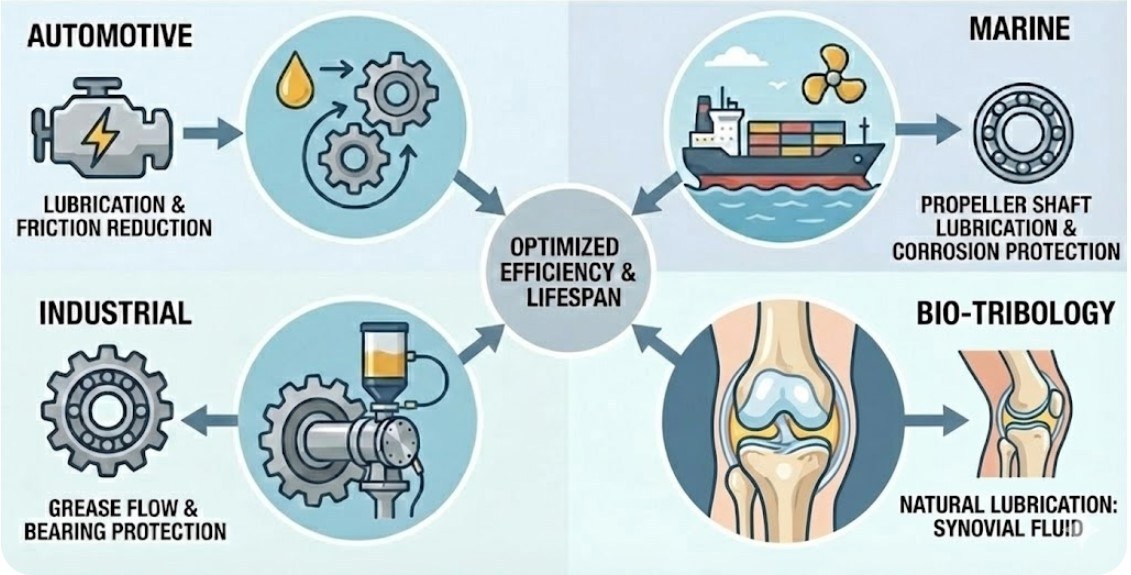
Friction and wear have almost become a part and parcel of daily life, viz., all devices used in our household, cars, airplanes, ships, heavy industrial machinery, movement of synovial bio-fluids present in human body (Figure 1). These contribute to some kind of energy consumption. Tribology plays a crucial role in reducing the energy losses and economic losses, enhancing machine durability through the investigation and optimization of friction, wear, and lubrication.
Efficient lubricant design reduces the environmental impact and emissions, maintaining peak performance facilitating sustainable industrial operations. Energy sustainability is the most widely explored and crucial area of research. Novel state of art materials are being developed and utilized as additives in conventional lubricants to significantly enhance the tribological properties.
Multi-functional energy materials have immense potential in this lubrication field thereby providing innovative solutions to climate action, affordable and clean energy goals of the United Nations. In our work, we have taken eight different engine oil-based lubricants that are used in marine applications. The grade of these oils varies according to the specific locations at which they are used i.e., in engines in crank shafts, turbines, and gears of marine ships, cruises etc.
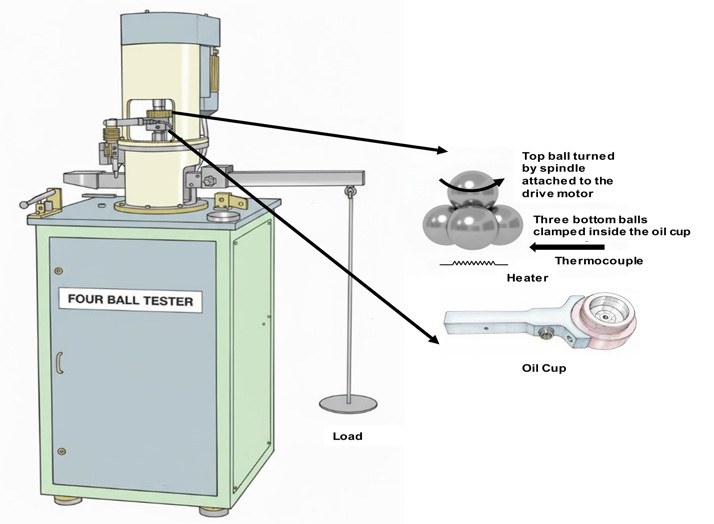
Here, the tribological investigation is done under varying speeds and temperatures in Four-ball tribo-tester (Figure 2). Coefficient of friction (COF), wear scar diameter (WSD), surface roughness (Rq) and wear depth (WD) are recorded for the given test conditions. The friction and wear data were analysed using recently developed order-constrained likelihood ratio test (LRT) based bootstrap methods to determine the optimal lubricant and optimal test conditions.
This synergistic methodology specifies the lubricant with optimal tribological behaviour. The reduction in COF, WSD, Rq and WD values can be attributed to the tribo-chemical reactions happening at the interface of the sliding surfaces. The lubricant molecules are composed of complex hydrocarbon chain structures.
Nuclear magnetic resonance (NMR) measurements indicate structural variations in different oils before and after the tests. The bonds C-H, C-C, N-O, and C=C in larger molecules break down into smaller fragments which recombine and chemically adsorb on the contact
surface leading to low shear strength tribo-film formation. Micro-nano gaps are filled by these recombined fragments to prevent any kind of direct contact. Furthermore, metal oxide nanocomposites were used as lubricant additives and dispersed in the optimal oils D and F [1].
Significant reduction was observed in the friction and wear values of the nano-oils at optimized test conditions due to nanoscale polishing effect and asperity filling mechanism. Table 1 report shows the tribological performance gains in terms of COF and wear depth reduction percentage in nano-oils after the addition of nanomaterials in base oils.
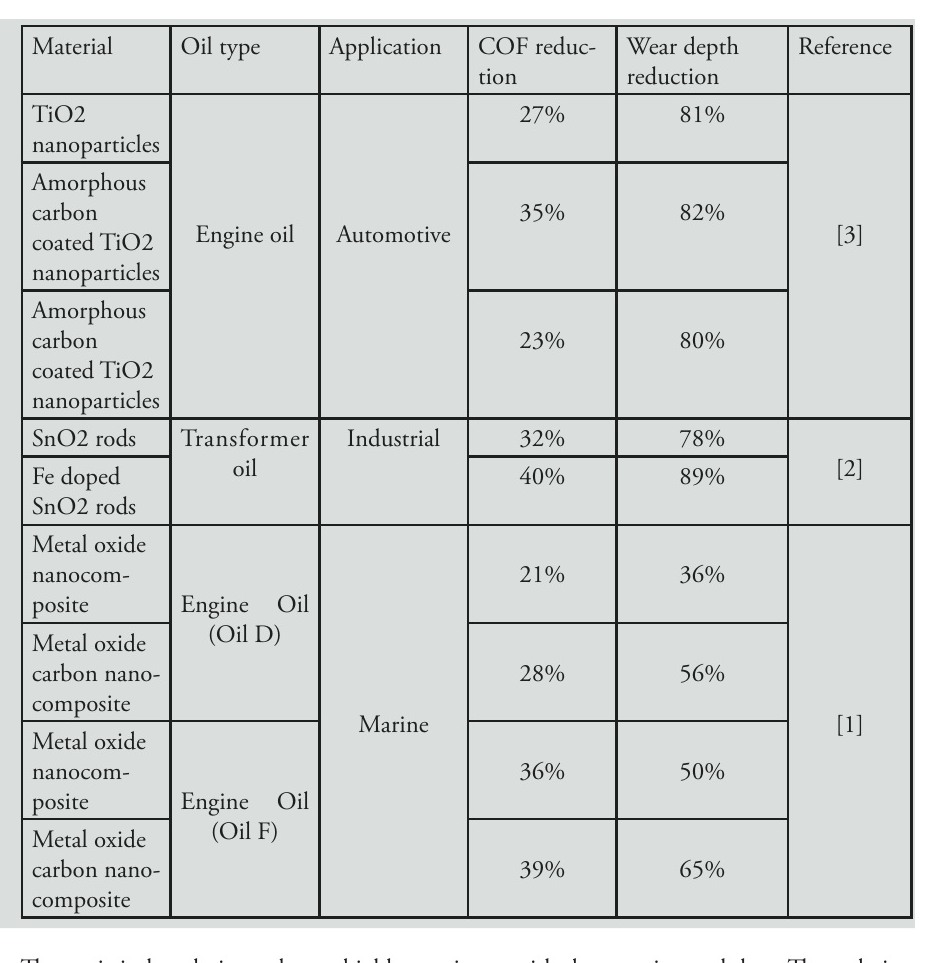
The statistical analysis results are highly consistent with the experimental data. The ordering of effects is done for the first time on huge data sets from lubrication studies using twoway ANOVA models. This synergistic novel strategy combining tribological experiments and bootstrap-based advanced statistical methods provide an in-depth knowledge of the factors influencing the lubrication behaviour for designing and selecting optimal lubricants.
The major study reported in this work are for marine settings, however our other publications highlight the tribological settings for industrial and automotive applications [2,3]. The maintenance engineer can utilize our approach for energy efficient lubricant design by variation of the factors viz., material, concentration, oil type, operating parameters etc. Our original publications provide different types of statistical analyses which hold potential in steel, cement, marine and power sectors.
ISO 4406 cleanliness codes are crucial for nanolubricants as large agglomerates may be seen as contaminants. However, the nanolubricants formulated in our work are optimally designed thereby maintaining good ISO guidelines. These well dispersed nano-additives are entirely invisible to the standard optical particle counters.
High dispersion stability is confirmed from the UV-visible spectroscopy analysis [2,3]. These materials are orders of magnitude smaller than the standard filtration ratings of industrial, marine and automotive applications. This allows these particles to pass through the standard filtration media without being trapped or leading to filter plugging.
Agglomeration may lead to stripping of the nano-additives out of the lubricant leading to tribological performance degradation.
References
- Shubhang Srivastava, Kamaraj Muthusamy, Ramaprabhu Sundara, Optimization of friction and wear behavior of industrial lubricants using novel bootstrap trend tests for tribological applications. ACS Industrial Engineering and Chemistry Research 2025, 64 (23), 11340– 11352, https://doi. org/10.1021/acs.iecr.4c04693.
- Shubhang Srivastava, Kamaraj Muthusamy, Ramaprabhu Sundara, Fedoped SnO2 rods as a sustainable lubricant additive for enhanced tribological performance: optimal selection using bootstrap procedures. ACS Langmuir 2025, 41 (36), 24660-24670. https:// doi.org/10.1021/acs.langmuir.5c02985.
- Shubhang Srivastava, Nisha Ranjan, Kamaraj Muthusamy, Ramaprabhu Sundara, TiO2 nanoparticles coated with nitrogen-doped amorphous carbon as lubricant additives in engine oil. ACS Applied Nano Materials, 2023, 6 (18), 16442– 16452, https://doi. org/10.1021/acsanm.3c02663.
About the Authors
Dr. Shubhang Srivastava
He is an Institute Postdoctoral Fellow in the School of Water Resources at IIT Kharagpur, India. He holds a Ph.D. degree from IIT Madras, and a master’s degree from Ulm, University in Germany. His research focuses on design and development of sustainable nanomaterials for diverse energy applications viz. nano-lubrication, nano-coolants, wastewater treatment, photocatalysis, and sustainability.
Prof. M. Kamaraj
Prof. M. Kamaraj is currently a E.
G. Ramachandran Institute Chair professor in the Department of Metallurgical and Materials Engineering at the IIT Madras. He has a vast teaching, research, and industrial experience in surface engineering, tribology, welding, and mechanical behaviour of materials with and without welded joints.
Prof. Kamaraj has published more than 250 research papers and five books.
Prof. S. Ramaprabhu
Prof. S. Ramaprabhu was E.
G. Ramachandran Institute Chair Professor and then Emeritus Professor in the Department of Physics at IIT Madras. His research areas are nanotechnology, hydrogen energy, fuel cell, batteries, lubrication, electrocatalysis, sensors, sea water electrolysis, etc.
He has guided 55 Ph.D. students and developed 10 technologies. He has published more than 460 research papers and filed more than 60 patents.
Keep reading