Bearing Lubrication
Mastering The Stribeck Curve: A Maintenance Engineer’s Guide to Bearing Reliability
A maintenance engineer's guide to bearing reliability, focusing on the transition between lubrication regimes to eliminate wear.
Executive Summary
Tribological research indicates that 70% of bearings lose their usefulness due to avoidable surface degradation. In the demanding environments of Indian Steel, Cement, and Power plants, mastering the transition between lubrication regimes and implementing the “5 Rights” (5R) approach is the difference between seamless operation and trillions of dollars in lost productivity. Proper lubrication does more than reduce friction; it facilitates heat dissipation, noise reduction, corrosion protection, and contaminant removal.
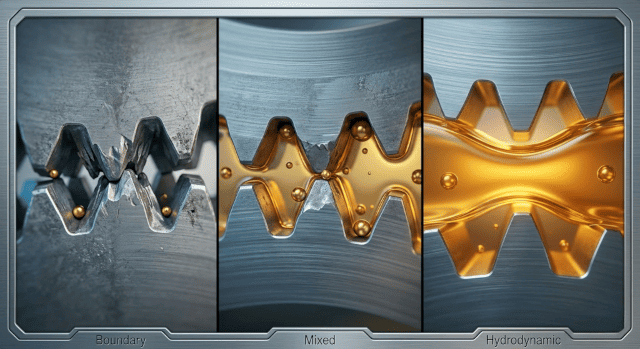
(Using the “5 Rights” to reach the gold-shaded “Full-Film” zone where virtually wear is liminated)
1. The Invisible Cost of Surface Wear
Mechanical wear is a primary driver of industrial inefficiency, with historical research by MIT suggesting that 6% of the U.S. GDP is lost annually to this phenomenon. Surface degradation—whether through corrosion, mechanical wear, or fatigue—can be directly attributed to ineffective lubrication practices.
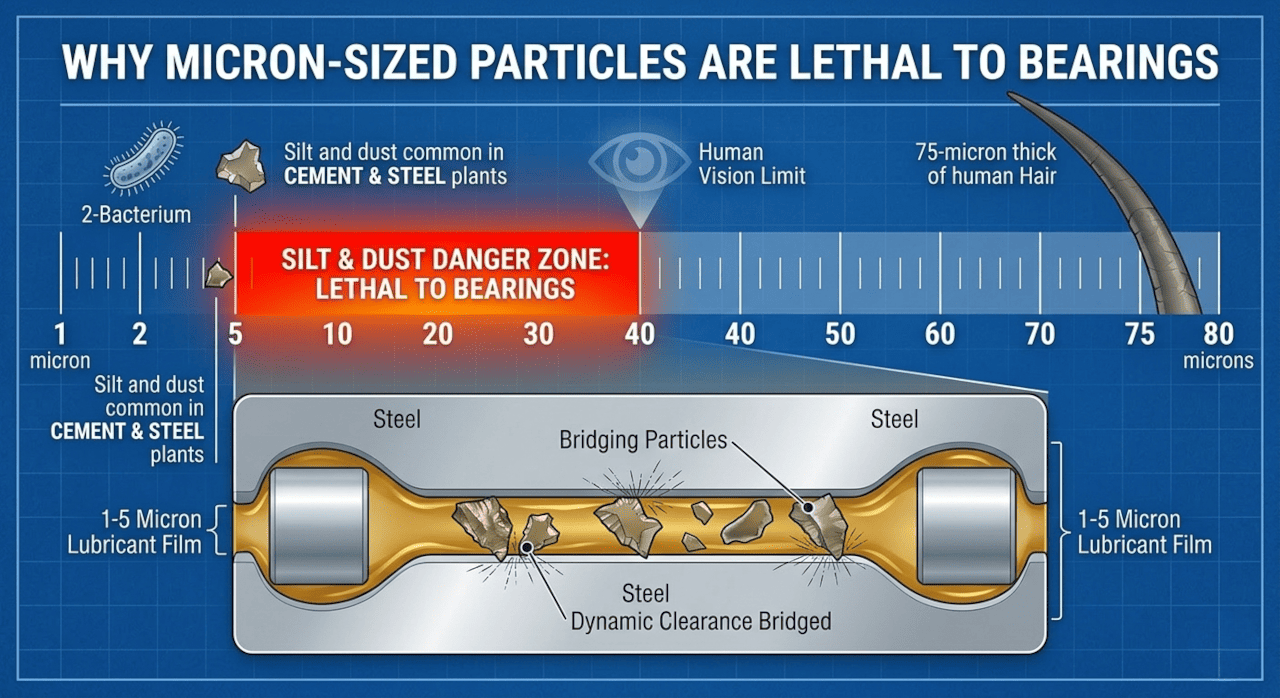
(Visualizing how a 5-micron silt particle bridges a 1-micron lubricant film, causing catastrophic surface damage.)
Common Pitfalls in Heavy Industry
- Under- and over-application of lubricants
- Contamination, specifically from particles and moisture
- Incorrect lubricant choice, including poor viscosity selection or inadequate additive packages
- Neglect of calculated service intervals
2. The Hierarchy of Lubrication Regimes
The level of protection a bearing receives depends on the thickness of the lubricant film, categorized into distinct regimes. The Stribeck Curve graphically depicts how friction relates to sliding speed, load, and viscosity.
A. Boundary Lubrication (High Friction / Low Speed)
- Condition: Opposing surfaces are in direct contact or separated by a minimal oil film.
- Characteristics: Over 90% of the load rests on surface asperities (microscopic peaks).
- Technical Risk: Accelerated wear and “welding” of asperities without proper anti-wear (AW) or extreme pressure (EP) additives.
B. Mixed-Film Lubrication (The Transitional Stage)
- Condition: Both surface asperities and the lubrication film share the load.
- Maintenance Focus: Requires stability under fluctuating loads and speeds to prevent shifting back into boundary contact.
C. Full-Fluid Film Lubrication (Optimal Separation)
- Hydrodynamic Lubrication (HDL): Occurs at high speeds where a thick film fully separates surfaces, common in steam turbines.
- Elastohydrodynamic Lubrication (EHL): Occurs under high loads where film pressure causes elastic deformation of surfaces, typical in gears and rolling element bearings.
3. Strategic Comparison for Plant Operations
| Feature | Boundary | Mixed | Full-Film (HDL/EHL) |
|---|---|---|---|
| Surface Contact | Maximum metal-to-metal | Partial contact | No contact; fully separated |
| Load Carrier | Surface peaks (>90%) | Shared between peaks/film | 100% carried by lubricant |
| Film Thickness | Minimal/Insignificant | Transitional | 1 to 5 Microns |
| Friction Level | Very High | Variable | Minimal (Internal fluid resistance) |
4. The “Invisible Killer”: Understanding Micron-Level Threats
In a full-film regime, the lubricant layer is incredibly thin—typically 1 to 5 microns. Because humans only begin to see objects at 40 microns, the particles that destroy your bearings are effectively invisible to the naked eye.
5. Conclusion: Implementation via the 5R Approach
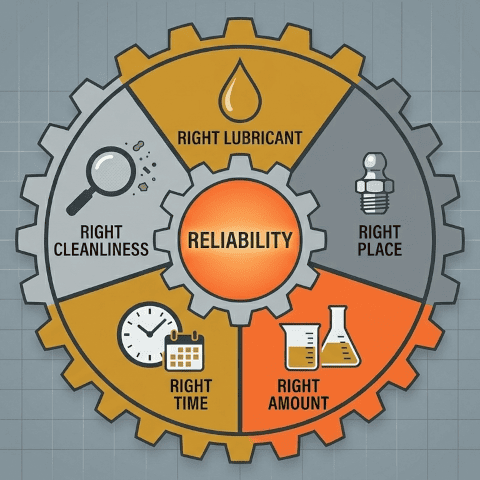
(A circular framework for maintenance teams to audit daily lubrication tasks.)
The fate of a bearing is in the hands of the maintenance department. To minimize surface degradation to negligible levels, plants must adopt the 5 Rights of Lubrication:
- Right Lubricant: Ensuring correct viscosity and additive packages for the load.
- Right Place: Ensuring the lubricant reaches the interaction zone.
- Right Amount: Avoiding the heat build-up of over-application or the wear of under-application.
- Right Time: Precise intervals to maintain film integrity.
- Right Cleanliness: The most critical factor in high-dust environments.
Keep reading